 |
| Baltimore skyline and harbor - photo by Patrick Gillespie, own work, CC BY-SA 4.0 |
by Mateja Mihinjac
Only two weeks after a tragic Baltimore bridge accident, we returned to Charm City for the second part of the SafeGrowth training workshop.
Like in most of our training workshops, students formed teams to work on problems in their own neighborhoods and this week they ended their 2-month training with some outstanding presentations to the public. The presentation day celebrated their successes, dedication, and commitment to bettering their neighbourhood.
THE FIVE TEAMS
In this SafeGrowth training workshop, we partnered with the Greater Baybrook Alliance (GBA), a truly excellent non-profit community development corporation responsible for improving liveability in three Baltimore neighbourhoods: Brooklyn, Curtis Bay, and Brooklyn Park.
Thirty participants were divided into five teams. They followed the 5-step SafeGrowth process where they identified and analysed their chosen problems, diagnosed harms, crimes, and the underlying causes, and then formulated solutions.
Just like in the Charm City documentary trailer, the teams identified violence and drug-related issues that have a devastating impact. Most importantly, they understood that they, as community members, play a crucial role in tackling issues together with the police, organizations like schools and businesses, and other partners.
 |
| One of the training venues in Baltimore county |
Team 1: Hanover Street (commercial street)
This team identified overlapping issues affecting safety and the feelings of safety. Those issues in turn led to major economic impacts and traffic problems in this culturally diverse commercial street: loitering, drug selling, littering, underlit areas, and several vacant properties. The team discovered how the vacant properties and lack of ownership contributed to street problems, including crime. This was easily observed by anyone walking along that street, especially after dark. They are in the process of formulating some practical responses.
 |
| One of the classroom design exercises |
Team 2: Brooklyn Homes Basketball Court
This team referred to their project area as “the forgotten place” due to the lack of desirable activity and increased fear of the area ever since a mass shooting at this location in July 2023. In their first training workshop two months ago, the team learned about the thesis of Jane Jacobs who described the crime risks in empty and vacated areas with no “eyes on the street”. This fits the situation at the basketball court.
The team first examined how youth congregated and what they did, and then examined problems with vehicle thefts, robberies, and aggravated assaults. This basketball court will undergo a redevelopment shortly and the team will ensure that they work closely with the partners and stakeholders in charge of the rebuild. Their goal is to ensure the basketball court becomes an activated space that fosters community engagement and social cohesion and thus regains its prominence in the neighbourhood as a positive gathering space.
 |
| Participants partnered with city and county police on problem-solving during project work |
Team 3: Team Landlord
Team Landlord choose to investigate a major problem of illegal renting and slumlord activity on neglected and vacant properties. This is a Baltimore-wide problem and it is often seen as a contributor to illicit drug activity and violence. The team confirmed this hypothesis and – because their analysis allowed them to associate problem properties directly to issues like drug use and drug dealing, prostitution, trafficking, loitering, and squatting – they were able to identify specific vacant properties as a major threat to safety and livability.
The team was excited to confer with some local legal experts regarding legal and regulatory strategies to mitigate the problem. They now have intentions to formulate a systematic solution that can influence the slumlord issue throughout the entire city.
 |
| The Greater Baybrook Alliance community organization was an outstanding facilitator of the SafeGrowth work in the three neighborhoods |
Team 4: Riverside Road Park - Brooklyn Park Champions
The Champions chose to tackle an empty lot on the city/county line that has also been forgotten and neglected. Consequently, as discovered by Team 2 on a different project, Jane Jacob's "eyes on the street" theory was also a factor in this property - it now attracted undesirable activity. In addition to speeding and trash dumping, the team uncovered petty crime, drug-related incidents, vandalism, assaults, and thefts from autos.
The team also pointedly recognised that all these issues visible on the surface are symptoms of underlying problems with poor social cohesion in the neighbourhood and lack of care or activation in the park. Their detailed analysis led to some initial strategies which, during their public presentations, allowed them to receive public feedback and narrow their responses even further.
 |
| Spanish speakers tackled school-related violence with considerable commitment to safety - they had children attending the schools |
Team 5: Ben Franklin High School
This Spanish-speaking team of vibrant residents chose to address the issue of school kids’ fights spilling over from Ben Franklin High School onto an adjacent alleyway. The fighting outside the school was worrying, but they were also concerned that the fights might worsen without some coordinated intervention. A few of the team members were mothers of young children, some attending the school, and they were concerned about the well-being and the future of their children.
The team conducted site visits to the property and received input from others in the area. Their crime analysis is still underway. This preliminary research reaffirmed their need for further study into the underlying issues for more comprehensive strategies. They have their homework to do! Foremost in their next steps was to develop partnerships with key stakeholders such as school officials and a nearby church adjacent to the alleyway. Equipped with more detailed research and data, this will be their next step.
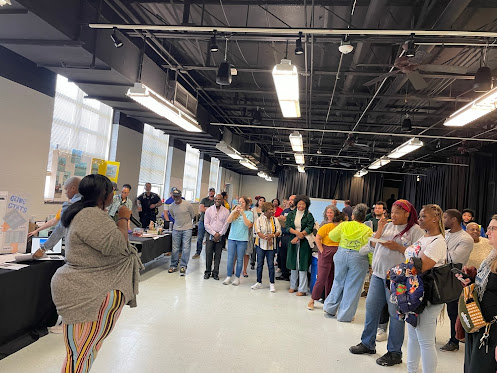 |
| Presentations during the poster sessions with about 70 members of the public. The community response was excellent |
 |
| GBA executive director, Meredith Chaiken, addresses the audience. GBA staff were outstanding, particularly director of public safety, Daisy Heartberg, & neighborhood safety coordinator, Yvette Bailey-Emberson |
INITIAL STEPS TO MOVE FORWARD
The teams have now made the initial steps towards solutions for their different problems through comprehensive SafeGrowth projects. But there is much yet to do. They will continue to build their projects in the coming months and then create partnerships along the way. As they finalize their partnerships and project schedule, they will then start implementing strategies.
The Greater Baybrook Alliance is examining a more permanent problem-solving process to address neighbourhood problems with their partners, such as businesses and police, and formulate a long-term plan for safety.
We are proud of the hard work of these teams of committed residents, business people, police, and others in the class. In a very short time, they accomplished an incredible amount of work as they applied the SafeGrowth philosophy, CPTED, planning concepts, crime analysis techniques, and project management. Their work is the mark of high-quality community leaders. The Greater Baybrook Alliance has launched an incredible community capacity-building process. This part of the “Charming City”, it seems, has a bright future!


.png)


.Jan23.jpg)


